

I consider myself the greatest fan of winter. It’s because the things that I love most take place in this season. Winter is the best time for storytelling, it’s when we have the time and space to share all sorts of stories. We meet every day with the girls for yarn spinning and as we work with the wool, stories are told one after the other. The other reason why I love winter is skating, of course, my favorite outdoor activity.
Despite my love for winter, every year by the middle of February I start to feel that I had enough of it. No more excitement for the snow, not for yarn spinning, storytelling, or for skating. I just feel like it’s time for something fresh and new to come. And I believe many others must have felt that way about it if they came up with the idea of a ritual for burying the winter around this time of the year. But this is not a sad funeral. On the contrary, it’s the funniest, craziest, and most cheerful celebration I know of.
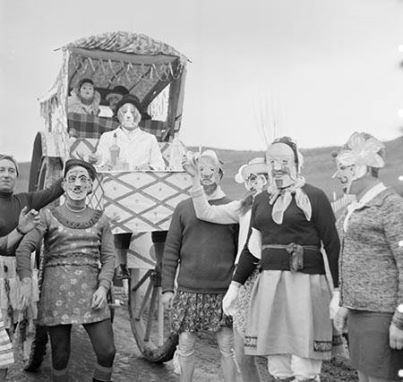
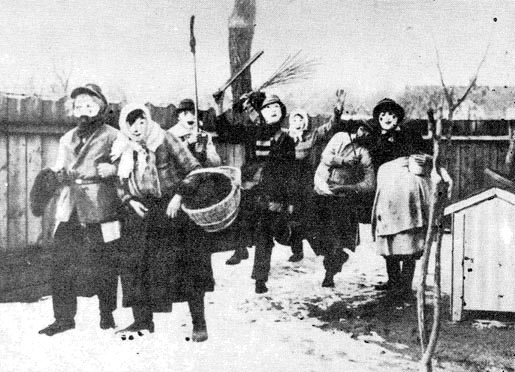
In Csekefalva, our custom symbolizing the burying and banishing of winter is a parody funeral of a human size puppet made of rags and straw representing the winter. The funny-looking puppet called Illés is carried around on the streets of the village with a dramatic funeral display which is actually a carnival. The regular characters of the traditional funeral are the pallbearers, the mourners, the costume characters, and the farewell speaker.
When I was a child in the 1920s, only men took part in the noisy, singing procession imitating a funeral. Women helped make and dress up the straw puppet in the spinning mill. Children and women were the spectators during the procession and we were laughing all the way.
The funeral procession took place according to the established funeral order. The costume characters waving onion wreaths were in the front of the procession. In the middle, the body of the straw puppet was carried, followed by the mourners. Most of the time musicians were also hired, who played cheerful songs. The funeral procession stopped at crossroads or other notable places, the straw man was placed on the ground and surrounded. The pallbearer or one of the pallbearers informed the village of the sad news, the death of winter.
After that, the wailing began, the text of which was recited by the men in a drawn-out, mournful voice, similar to an actual wailing for the dead. The puppet was carried through the village and the mourning scene was repeated in several places.
It was common for most houses to offer drinks and cake to the members of the procession. During the procession, before and after the mourning scenes, the costume characters sprinkled ashes on the spectators. The spectacle lasted for several hours and it was finished at the end of the village or in front of the pub. They bid farewell to the straw puppet and then burned it. During the burning or immediately after everybody started dancing.
Nowadays this winter banishing ritual is still practiced in most villages of our region. There have been some slight modifications over the past 100 years, or there might be small differences between villages, but essentially the customs and their significance are pretty much the same. It is time for the spirit of winter to leave.
As a child, I thought this is a unique celebration that is practiced only in our region. But when I grew up and traveled the world, I realized that most Roman Catholic populations have some type of similar custom. Some call it Mardi Gras, others call it Fat or Shrove Tuesday, and some consider it just a carnival. No matter how we call it, the end of winter is a cause of celebration and joy. It’s the time of endings and new beginnings. It’s time for life to blossom once again. So, let’s say goodbye to winter and welcome spring!
Klárika



 CYBERNOVELS L'20S