

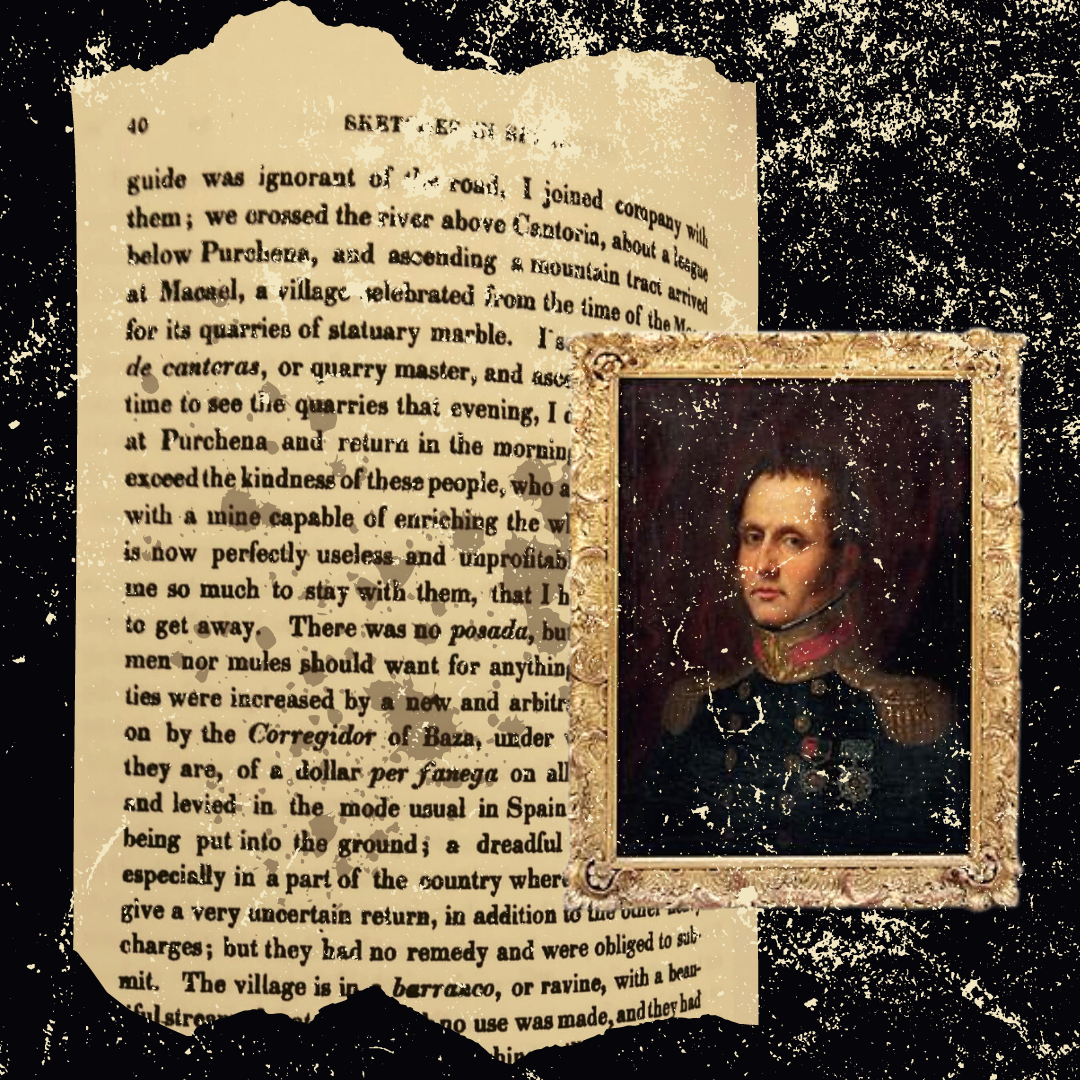
An English traveller at the Posada
My dear friends:
Today I will not be the one to tell you about Purchena. You should know that in the 19th century, numerous travellers from other European countries felt an insatiable curiosity to discover the most exotic and distant countries of the time. Many travelled to the Middle East, to Asia, and many others to the Mediterranean. Only the most privileged could undertake the road trip from the United Kingdom, France or Germany, and they were so fascinated by the diverse and authentic realities they encountered that they were named as the romantic travellers.
Granada, Ronda or imperial Madrid were on their list, but who would have thought that one of them also visited Purchena. The English traveller Samuel Edward Cook toured our country for several years, from 1829 to 1832. He fell into a state of inebriation when he was in Spain, and described not only the political and economic functioning of the time, but also the clothing, social classes, character and culture of many villages on the Peninsula.
Without further ado, I leave you with the transcription of his brief stay in Purchena, which lasted only one night, but in which he did not hesitate to gift us with beautiful words and a memory that, thanks to his writing, will be indelible and always remembered. Thank you, my dear friend, Samuel.
_______
The district which includes the maritime parts of the kingdom of Murcia and the western portion of Valencia, with the eastern end of Andalusia beyond the influence of the Sierra Nevada, is the driest in Europe; it is sometimes nine or ten months without rain; the vapour is arrested far in the interior by the Sierra de Segura, which forms its barrier to the north.
It possesses unequalled advantages for agriculture, but there are no pantanos, or reservoirs, from the want of which nearly the whole country, excepting the vale of the Segura, is like an African desert. No place, excepting for the harbour, can be more unfit for a naval station. There is no resource whatever at hand, excepting the pine timber of the Sierra de Segura, which is only fit for interior uses, and, like every thing in the navy of Spain, it resembled an exotic or forced plant, and has sunk as the enormous expenditure with which it was sustained has been withdrawn. The place is entirely decayed. I could not procure a horse, and was obliged to geologize on foot.
Being unable to hire animals to cross the mountains, I took a tartana, and proceeded by carriage road to Almazarron, which is a large village in a valley, about a league from the sea, and enjoys a more temperate and healthy air than Cartagena. […] I hired mules for Almeria, intending to proceed by Macael and Purchena.
[…]
We passed some miserable villages in the most lovely situations. The road was chiefly by the wide and gravelly bed of the river. In the afternoon I came to Almanzora, the site of a favourite palace of the kings of Granada. It stood on a small eminence or knoll, the river washing the foot of it. A spacious cortijo, or country house with farm offices, built in the last century, now occupies the site, and not a Moorish fragment is left. Every tree has been carefully removed, and it is now in the midst of an open desert. The villages higher up are better built, but I could procure no wine, although the country is celebrated for it. We overtook a drove of asses, and ascertaining from the leader they belonged to Macael, as my guide was ignorant of the road, I joined company with them; we crossed the river above Cantoria, about a league below Purchena, and ascending a mountain tract arrived at Macael, a village celebrated from the times of the Moors for its quarries of statuary marble. I sent for the maestre de canteras, or quarry master, and ascertaining I had not time to see the quarries that evening, I determined to sleep at Purchena and return in the morning. Nothing could exceed the kindness of these people, who are extremely poor, with a mine capable of enriching the whole district, which is now perfectly useless and unprofitable. They pressed me so much to stay with them, that I had great difficulty to get away. There was no posada, but they said neither men nor mules should want for anything. Their difficulties were increased by a new and arbitrary tax lately laid on by the Corregidor of Baza, under whose jurisdiction they are, of a dollar per fanega on all seed corn sown, and levied in the mode usual in Spain previously to its being put into the ground; a dreadful and ruinous tax, especially in a part of the country where the crops of corn give a very uncertain return, in addition to the other heavy charges; but they had no remedy and were obliged to submit. The village is in a barranco, or ravine, with a beautiful stream of water, of which no use was made, and they had not the slightest idea of saw or polishing mills for the marble. I fixed with the maestre to meet him in the morning, and went to Purchena, which I was anxious to see. It is about a league distant. On entering the town I inquired of an old woman if there was a posada? “Si señor, hay una, nueva, hermosa.” It had a most inviting appearance, but the interior turned out to be a mere shell, all the back part being unfinished, and the only habitable room was occupied by a commercial traveller. I arranged to sleep in the open space at the entrance, and inquired what was to be had for supper; was there mutton? “Hush! habra.” “Wine?” which is celebrated. “Tambien habra, pero no diga v. nada.” The meaning of this was, that there was a monopoly of these articles in the place, most probably by the Ayuntamiento, and that the articles sold publicly were dear and bad, and must be procured in other quarters. As I was retiring to rest, an alguazil came to say the Alcalde wished to see me. He was a gentleman, the place being of some consequence. He asked me a few questions very politely, which he was quite justified in doing, as the times were very critical, and I was out of the direct route, and in a place very seldom visited. I explained my object, and he said “Pero que necesita v. en la Peninsula?” but what brings you to the Peninsula? I answered that I had permission from my own government and from that of Spain to travel, which I supposed sufficient. He instantly gave me the passport, which was already signed; saying “vaya v. con Dios.” Purchena, which possesses great historical interest, from its being the residence of the Re Chico after the surrender of Granada, is situated at the foot of the Sierra de Filabres, the eastern shoulder of the Sierra Nevada. The ruined castle occupies a lofty cliff at the back, and below it is the junction of two branches of the Almanzora. The country is beautiful, but is now almost entirely divested of trees. The town, which contained seven thousand houses in the time of the Moors, how now barely four hundred. The situation is of great importance, as it commands, the whole vale of the Almanzora and the sea at the south, an easy communication with Baza and with Lorca by Cuevas, as well as two lines of road to Almeria and the mines of the Sierra de Filabres. In the course of the evening, a variety of characters assembled from the village. I endeavoured to get information about the route for the next day, intending to cross direct from the quarries of Macael to Almeria. The maps were of no use. No two accounts agreed. No one knew more than the road they always frequented, which was a line higher up the Sierra; and represented the other impracticable, or full of robbers: they could not agree in the distance within several leagues, and I had to follow my own plan and trust to the chance of finding a line in the direction I had planned. In the morning I returned to Macael, taking Antonio Vicarro, the maestre de Canteras, and a guide to put me in the route to Almeria.
____
Samuel Edward Cook continued his journey through the sierra towards Almería, after which he made his way up into the Alpujarras.
The Victorian Era was a period of great splendour for England in particular, but I can only be happy that Samuel Cook visited us and left his mark on our small, rugged village.
Take care,
Clarita
 CYBERNOVELS L'20S