

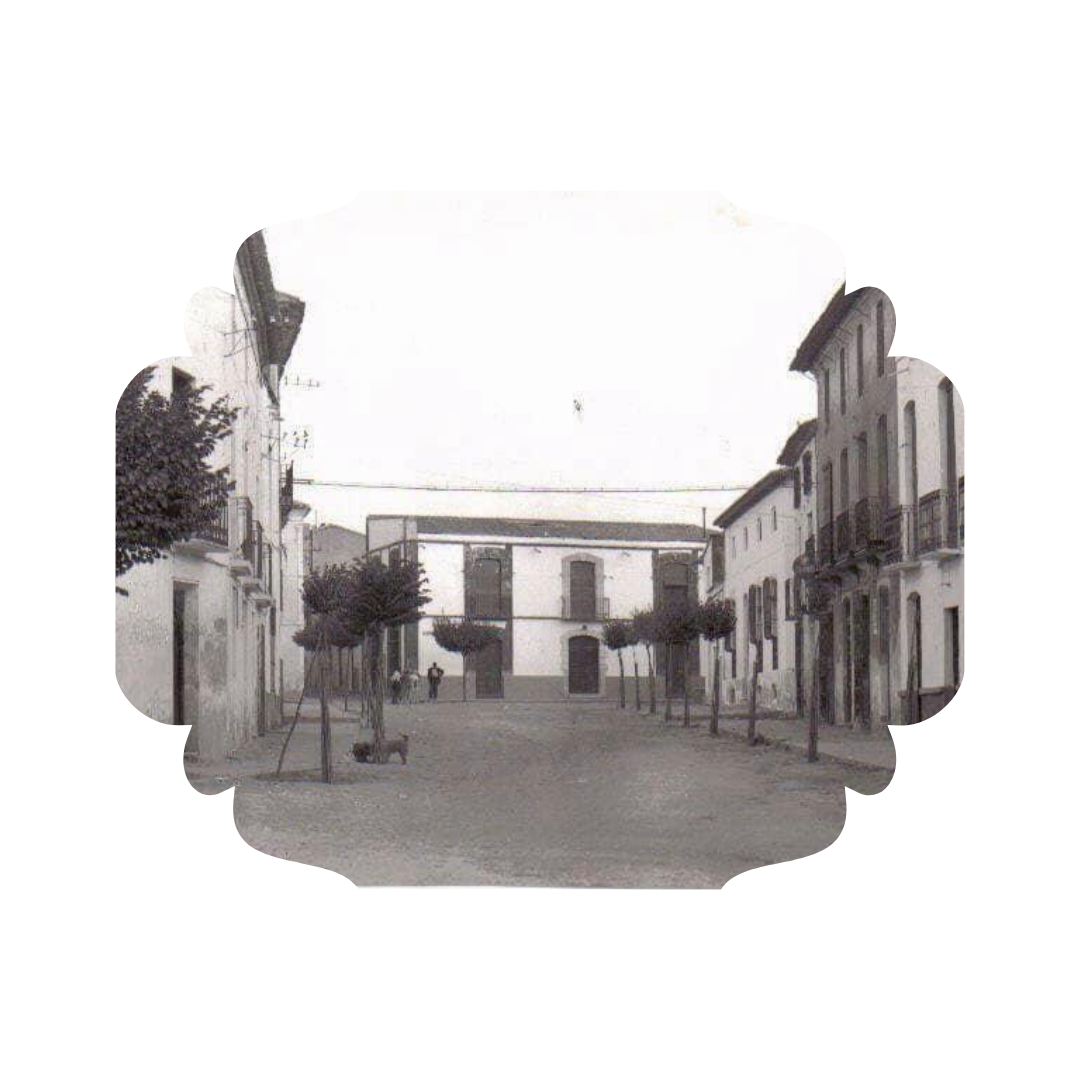
Curtain-up!
Last night I couldn’t sleep. I tossed and turned in bed, read for a while, drank a glass of milk… Nothing. Sometimes I suffer from inexplicable insomnia. Maybe it’s the jet lag from time travel. This last one has been over 120 years, phew! Almost nothing.
The thing is that, tired of this, I opened my eyes in the middle of the darkness and from my bed I could see a discordant light flickering and illuminating the Purchena bell tower of 2022. It has been like this for some months now, I doubt whether it is a coded message or a malfunction that has gone unnoticed.
In any case, I got nothing out of trying to decode the light signals with my limited knowledge of Morse.
When I had given up, I was struck by the thought of the invention of electric light, which made me reflect on its importance in our lives today. In the last episode, if you remember, I told you the story of a murder in Purchena, where the atmosphere was still gloomy and things were lit by candles and oil lamps, as electricity was still a long way off.
I started to feel sleepy after a while, and in the end, I closed my eyes and fell into a light doze. I don’t know if it was long or short, but my sweet slumber was interrupted by the cheerful bustle and the whiff and crackle of lanterns being lit.
Disoriented, I wondered to myself: —Lanterns lighting up? How, have I travelled back in time without realising it? I can’t go back to sleep in another era, I might never wake up—I thought, frightened.
I had no choice but to go down to the village and wait for that evening’s bedtime in a year still unknown to me. I hurried down and saw that in the square people were milling about in noisy, excited huddles. A kind of absurd intoxication reigned in every corner of the square, beginning to light up little by little. I decided to come out of my state of invisibility and put on some clothes similar to what the people were wearing, luckily I wouldn’t look too out of place.
I approached the night watchman, who was lighting the lanterns with plenty of verve, and said to him:
—Good evening Sir, could you tell me what year it is?
The night watchman, with black dirt spots on his face, said to me, «It’s 1920, miss. I’d better not ask you what year it is you came from…» he said quietly, laughing.
So it was 1920, and what a pleasure it was for me to have travelled back to a decade so dear to me!
The truth is that in that year, the world was witnessing numerous changes. In our country, two elections had been held in the last two years, and the political sphere did not seem to have stabilised at all.
At the beginning of the decade, the Spain of King Alfonso XIII was dreaming of modernity and progress, while at the same time it was still sinking into the problems that had dragged on for decades, such as war, political chaos and, more recently, the Spanish flu pandemic. Oh, by the way, the disease did not originate in Spain. It was called Spanish flu because our newspapers reported the appearance of the first cases, and it was therefore thought that it originated here. Many other countries, immersed in the First World War, would not shoot themselves in the foot by raising the alarm about a disease that was claiming its dead like chess pieces.
I looked around me, amused by the joy in the air, the light dim the lampposts reflected… So it happened that electricity had still not arrived in Purchena, huh! It would take three or four more years. Still, I was overcome by a bizarre sense of happiness, and I was convinced that it was being transmitted to me by the crowds in the Plaza of Purchena. They were beginning to dissolve and were walking down the Plaza Larga towards a facade with more street lamps lit and large vases of iris and violets.
I finally reached the place where the people were crowding. I was struck by the hats worn by a few ladies, very few among the majority of capped and humble-looking men. The ladies, and the gentlemen accompanying them, entered first into what, looking at the top of the facade, I saw was called the Teatro Almanzora.
The letters that made up the sign were arranged splendidly on the white facade in a brilliant emerald green colour. The black shading gave depth and elegance to this marvellous purchenero theatre of which I was unaware. The large crowd thinned as everyone entered, and I caught a glimpse of the large theatrical poster inside the display cabinets on either side of the entrance door.
It announced the inauguration of the Gran Teatro Almanzora in Purchena.
Next to a photograph of a beautiful young lady, it read:
Shows Empresa Praga S.A.
«At half past seven o’clock SHOW IN HONOUR AND BENEFIT of the beautiful and remarkable Paquita López, an artist of exceptional merit, excellent singing and luxurious costumes. Splendid in canzonetas and cuplé fino, as well as in regional singing.
Accompanied by Los Valencianitos, an orchestra made up of musicians of sensational quality in the show AGUA QUE NO HAS DE BEBER, a huge success for this company.”
Wonderful, fantastic! I exclaimed, and I rushed into the theatre, taking some coins out of my little cloth bag to buy a ticket. It then dawned on me that it might be better to attend the performance in my invisibility mode, as a girl alone in such a circumstance might attract uncomfortable glances and indiscreet questions. «Better to save me a headache and enjoy Paquita López y Los Valencianitos from the central aisle, my favourite place,» I thought.
You can’t imagine the ovation that the Purchena audience gave to the musicians and the canzonetista, what warm spectators, how generous we purcheneros have always been!
As I left the theatre, and as boys, children, ladies and elder people were dissipating, I realised why we have attached the adjective “roaring” to the twenties.
—I hope to be back very, very soon, I said yawning to the night watchman who was turning off the last lampposts on the theatre facade.
Now it’s time to sleep.
Good night,
Clarita
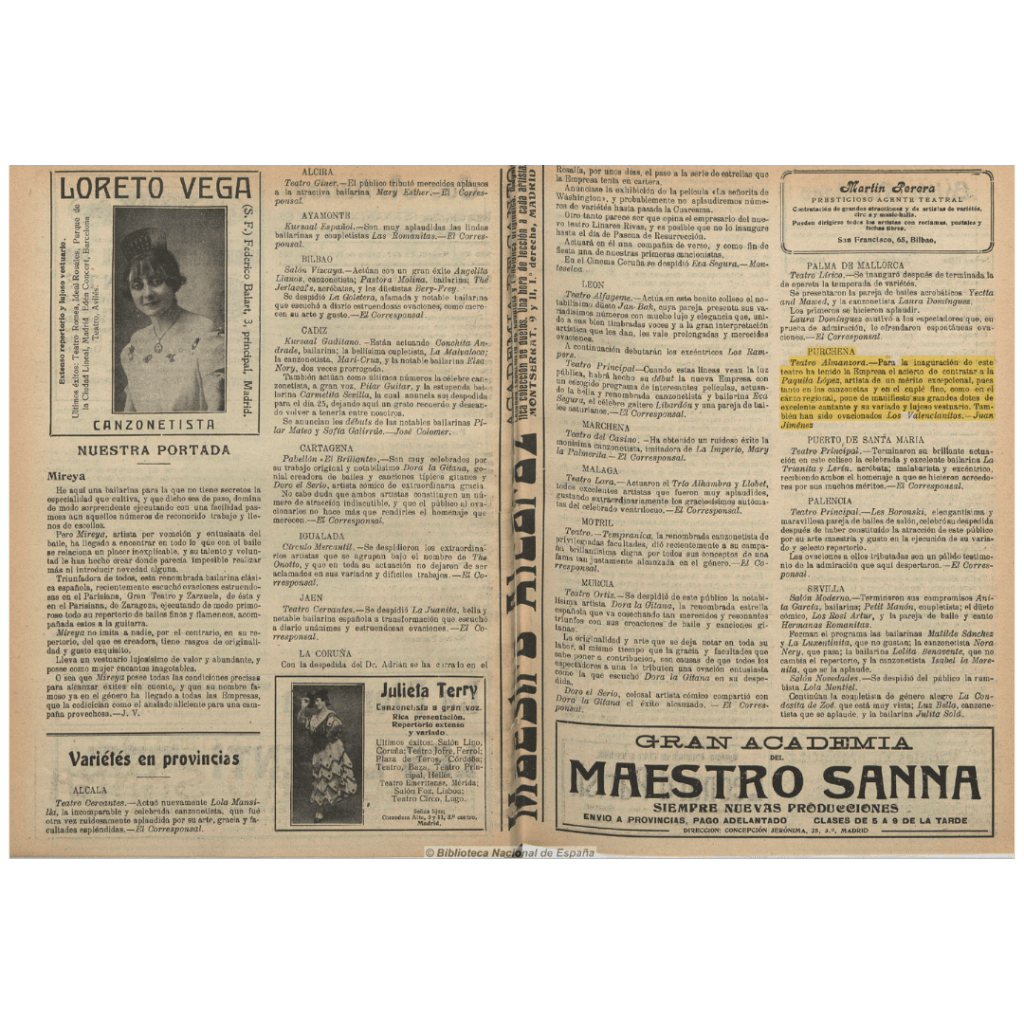
Author’s note: this story has been fictionalised from the real news piece retrieved from the National Library of Spain’ Archive.
 CYBERNOVELS L'20S